|
WOOD/EPOXY
BOATBUILDING
NEWS & BOAT BUILDING
TECHNIQUES:
Hi fellow boat builder, this is the start
of our on line - BOAT BUILDING NEWS
-
which will
be updated on a regular basis. We can only share with you a fraction of the information
included in our BOATBUILDING E-BOOKS. You can
email us regarding specific boatbuilding questions and we will be pleased to give you a
prompt reply. In the meantime ...good boat building ....from us all at Bruce Roberts.
Suggestion! Let this and other pages of this site DOWNLOAD or on USB memory
stick into your hard disk and view at leisure. Please email me your comments on our
site....criticisms as well as other comments please.
MOLDED PLYWOOD
OR VENEER
This method of construction can be used to build several of our designs,
and boat plans are available based on this technique. From full size patterns supplied with the
boat plans , station frames are marked and cut out of scrap timber and plywood. Stringer
positions are marked and notched. The frames are erected on a prepared strongback and the
stringers, keelson and stem are added. Very little fairing off is necessary as the
stringers go in at the correct angle and allow the plywood or veneer strips to be added
glued and nailed to the stringers.
The plywood or veneer strips are applied diagonally and sometimes
vertically and fore and aft as shown in the boat plans. To ensure a good bond between the
layers, staples are used to pressurize the glue while this hardens. If silicon bronze or
stainless steel staples are used they may be left in the hull.
|
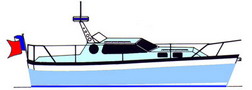 |
Waverunner 24 W - SEE MORE
( Planing hull )
WOOD / EPOXY
POWERBOAT plans & FULL
SIZE FRAME PATTERNS
ALL boat plans & Full size patterns come with a BONUS DOWNLOAD or on
USB with FREE a dinghy plan, rigging boat plans, placement of anodes, how to build a sea hood, how to
build fuel & water tanks, engine installation details, electrical
schematic & plumbing details; all included to assist you to build & complete
your boat. |
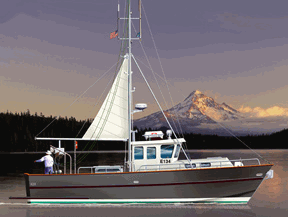 |
COASTWORKER 28 - 32- 36 - SEE MORE
FISHERMAN WORKBOAT
WOOD EPOXY or ALUMINUM
boat plans & FULL SIZE FRAME PATTERNS
Package Includes
latest building plan updates & revisions, PLUS direct
contact with the designer Bruce Roberts-Goodson
EMAIL BRUCE
ALL boat plans & Full size patterns come with a BONUS DOWNLOAD or on USB
with FREE a dinghy plan, rigging boat plans, placement of anodes, how to build a sea hood, how to
build fuel & water tanks, engine installation details, electrical
schematic & plumbing details; all included to assist you to build & complete
your boat. |
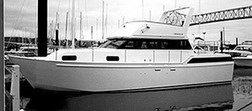 |
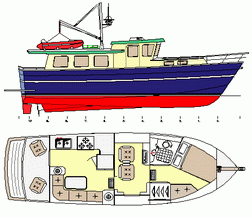
Waverunner 342 - SEE
MORE
(SEMI-DISPLACEMENT OR PLANING HULL)
STEEL, ALUMINUM, WOOD / EPOXY or FIBERGLASS BOAT PLANS & FULL SIZE FRAME PATTERNS
|
 |
Coaster
TY 28 - 32 - 36 SEE MORE
WOOD EPOXY BOAT PLANS & FULL SIZE FRAME PATTERNS
|
|
|
COASTWORKER 28 -
32 - 36 -
SEE MORE
FISHERMAN WORKBOAT
WOOD EPOXY or ALUMINUM
BOAT PLANS & FULL SIZE FRAME PATTERNS
Package Includes
latest building plan updates & revisions, PLUS direct
contact with the designer Bruce Roberts-Goodson
EMAIL BRUCE
All BOAT PLANS & Full size patterns come with a BONUS DOWNLOAD or on
USB MEMORY STICK with FREE a dinghy plan, rigging boat plans, placement of anodes, how to build a sea hood, how to
build fuel & water tanks, engine installation details, electrical
schematic & plumbing details; all included to assist you to build & complete
your boat. |
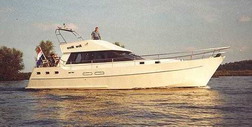 |
WAVERUNNER 44 - SEE MORE (Semi-displacement or Planing)
STEEL, WOOD/ EPOXY
boat plans & FULL SIZE FRAME PATTERNS |
|
NEW |
MEDITERRANEAN 45 - SEE
MORE
WOOD EPOXY
OR FIBERGLASS
boat plans & FULL SIZE FRAME PATTERNS |
![wr45-06[1].jpg (18379 bytes)](images/wr45-06[1].jpg)
![wr45-10[1].gif (19945 bytes)](images/wr45-10[1].gif) |
Waverunner
45 SEE MORE Version B (Aft Cabin)
(Semi-displacement or Planing)
WOOD EPOXY
STEEL
or FIBERGLASS
BOAT PLANS & FULL SIZE FRAME PATTERNS
ALL boat plans & Full size patterns come with a BONUS DOWNLOAD or on USB
- YOU CHOOSE DOWNLOAD OR USB
. . .with FREE a dinghy plan, rigging boat plans, placement of anodes, how to build a sea hood, how to
build fuel & water tanks, engine installation details, electrical
schematic & plumbing details; all included to assist you to build & complete
your boat.
Waverunner
45 SEE MORE
Trawler version
WOOD EPOXY
STEEL
or FIBERGLASS
BOAT PLANS & FULL SIZE FRAME PATTERNS |
SEE MORE
|
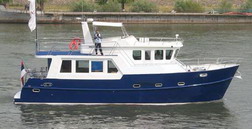
TRAWLER YACHT 485 WOOD EPOXY
BOAT PLANS & FULL SIZE PATTERNS
ALL boat plans & Full size patterns come with a
BONUS DOWNLOAD or on USB MEMORY STICK -
with FREE a dinghy plan, rigging boat plans, placement of anodes, how to build a sea hood, how to
build fuel & water tanks, engine installation details, electrical
schematic & plumbing details; all included to assist you to build & complete
your boat. |
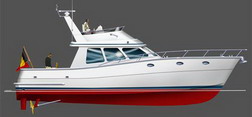 |
ATLANTIC
550 / 17m SPORT FISHERMAN
WOOD EPOXY BOAT PLANS & FRAME
PATTERNS
|
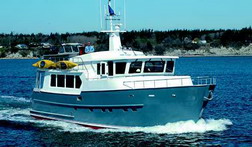
Similar design shown
SEE MORE |
PASSAGEMAKER TY 585
WOOD EPOXY
COMPLETE boat plans & FULL
SIZE PATTERNS
Plus BONUS boat plans plus FREE
e-BOAT BUILDING BOOK
PLAN PACKAGE includes latest sail
boat plans, sailboat building plan updates & revisions, PLUS direct contact with the
designer Bruce Roberts-Goodson |
 |
EURO 2150 Motor Yacht
WOOD EPOXY BOAT PLANS &
PATTERNS |
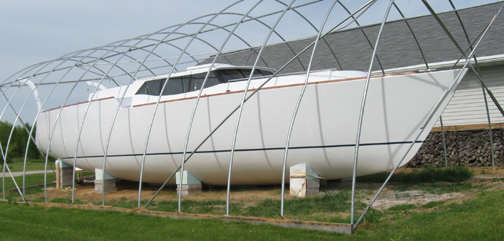 |
ROBERTS 434
WOOD EPOXY
Hi Bruce,
Here is an update on my boat
construction of your ROBERTS 434. The more I get into this project the more I am
admiring your skills as a navel architect. I just realized that the engine
can be made to easily be pulled up thru the cockpit floor without damaging
the rest of the vessel. Fantastic! When I attended the Chicago boat show
last winter, I did not see that at all on the factory models; in fact the
engine compartment was so compact, I pitied the mechanic that had to work on
it.Have a Spiffy Day! Earl |
|
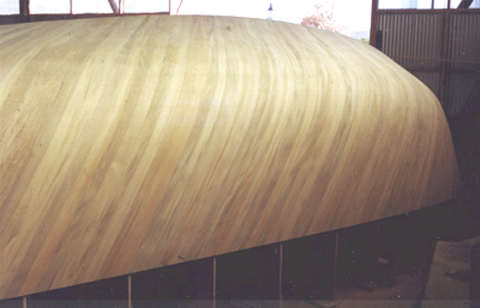 |
CENTENNIAL SPRAY 38
WOOD / EPOXY
Diagonal veneers added after strip planking is completed. |
|
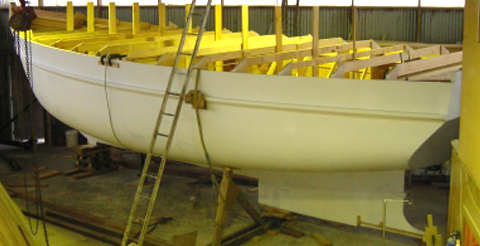 |
CENTENNIAL SPRAY 38
WOOD / EPOXY
Hull upright ... pattern has been made for ballast keel
& this will be installed at later stage. |
|
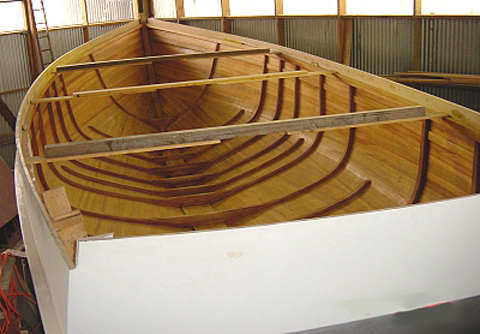
Interior framing added as per boat plans. |
Hi Bruce, Just thought we'd update you with the progress of
our CS38. As of today the 30th of May, we're past halfway through planking the first
diagonal layer on the hull. We completed fairing the fore and aft strip planking early
last week. We have a small web page up showing progress (of course it IS about 3 weeks out
of date, but there's a lag in getting film out of the camera!): Regards, Rob
McGill & Nina Morissette
See complete
list of Sail & Powerboat plans for building in wood |
|
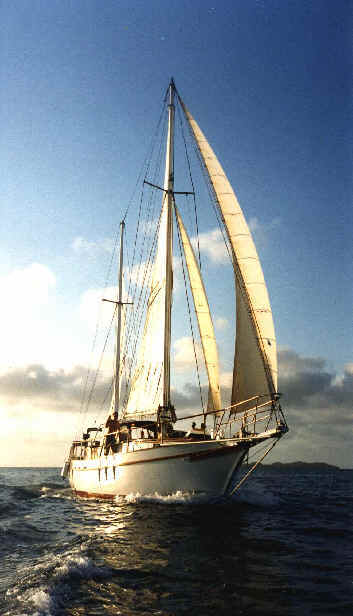 |
“BOUNDER”
Ketch Rigged SPRAY 45 Wood /Epoxy
LENGTH:
Overall 52’…On deck 46’ BEAM 20’-0
DRAUGHT Cruise 5’6” DISPL:
Empty 20 tons Loaded 22 tons.
CONSTRUCTION:
West System, using double strip plank and epoxy resin,
and
covered with a heavy epoxy/fiberglass skin. Outside ballast keel of five tons |
|
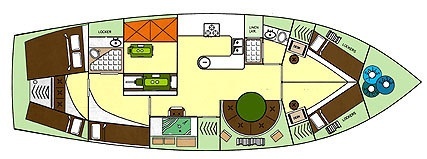 |
SPRAY 45 Wood /Epoxy
NEW
VERSION 'B'
boat plans and patterns available
for wood/epoxy
construction
MORE INFO CS45
MORE INFO CS38
MORE INFO CS36
MORE INFO CS34 |
|
![r470-04[1].gif (9835 bytes)](images/r470-04[1].gif)
|
ROBERTS 470
WOOD EPOXY
This Wood/Epoxy sailboat was built in Turkey
and is currently operating as a charter boat in that area. The operation has been
sufficiently successful to enable a second vessel to be ordered from the same builders.
Study boat plans Available
MORE INFO Roberts 470
|
|
 |
ROBERTS 532
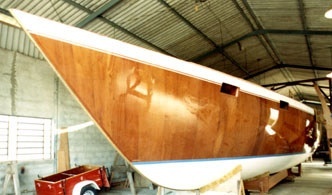
This molded veneer Wood/Epoxy hull was built in
Brazil where good timber is still relatively plentiful. Many Bruce Roberts designs are
available for use where this method of construction can be used.
MORE INFO
BUILDING TIP: When installing veneers or
other material that requires temporary staples, one of the most onerous jobs is removing
the staples. Many methods have been tried but this one successfully used by Russ Stevenson
works well....buy some narrow THIN packaging METAL tape and this can be used underneath
the staples....easy to remove when the glue has set...simply give a hefty tug on one end
of the tape and the staples come out without a whimper...make sure to wear goggles as
staples may fly in all directions.
|
|
 |
SPRAY 28
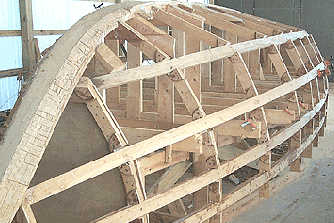
This boat is being built by Phoenician Yachts
This and several other Spray designs can be built in sheet plywood as well as
the many CENTENNIAL Spray strip plank versions.
See complete list of
Sail & Powerboat plans for building in wood |
Dan
Aadland:
Building of his Spray 27 in Wood Epoxy
The lifelong desire to sail has prompted my present (major) project, a
Spray 27 cutter designed by Bruce Roberts. This is the second smallest of his Spray series
and the larger of the two trailerable ones. A multi-chine plywood design, the cutter can
be built with either marconi or gaff rigs and in either pilot house or conventional
sailboat configuration. Luckily, decisions on those two matters need not be made until
bulkheads are installed, so I have a while yet to decide.
I made two modifications. First, the Sprays have a conventional transom which turns to
vertical for the upper one foot. I kept the taper of the transom all the way aft, which
will increase cockpit (or lazarette) space and overall length (to about 28'). The shape is
more pleasing to my eye. Secondly, I am building the hull with a modified stitch-and-glue
or, more accurately, epoxy chine method. I’ve built the hull over the same temporary
frames specified but eliminating the chine logs and instead edge-gluing the plywood panels
with filled epoxy. The hull is roughed in and when fibreglasses will be turned over with
the temporary frames still supporting it. At that point the fillets of filled epoxy will
be installed inside as the chines. This modification was done with the blessings of Mr.
Roberts himself, incidentally.
A Spring ‘99 Update: I completed the planking, built up the keel with fir, and built
a steel ballast box to be later filled with lead and thickened resin. This ballast
box, still empty, was fitted into place and the wooden keel laminated up around it.
Then I removed it to be bolted in position later with the hull upright. I also
located an old-but-good Yanmar 8h.p. diesel, the old horizontal cylinder model, and
purchased it for later installation.
A stern view of the hull, now covered with 6 oz. fiberglass cloth set in epoxy
resin. (Much sanding and fairing remains before it will be ready for paint.)
To turn the hull we had, naturally, a party. Two heavy Polly ropes were run from the
ends of the trusses on each side of our pole shed, under the hull (but over the building
form), then to cable-type “come-along's.” To protect the hull we padded
the area with tires and also put foam pipe insulation over the ropes. Then we
cranked on the come-alongs until the hull lifted off the form. We lifted the hull until it
went over gently onto the ropes. Then everyone quickly skidded the building form
forward out of the way. Then we pushed the hull back onto the concrete building
platform and blocked it.
Final positioning of the hull was easy, and with this nice old-fashioned straight
keel design, the hull ended up dead level with the waterline (as shown by the marks on the
temporary frames still inside). Emily and I posed in front of our sailboat to be,
then she posed me by the stern. We’re tentatively planing to name the boat Sjo
Hest, “sea horse” in Norwegian, a marriage of our Scandinavian heritage and our
preoccupation with the world of horses. Hopefully it will take us over the waters of
Puget Sound and the Sea of Cortez. Watch this space for more on the
building of Dan Aadland's Spray 27
MORE INFO Spray 27 |
![s27-08[1].jpg (9077 bytes)](images/s27-08[1].jpg)
Setting up the frames |
![s27-10[1].jpg (22987 bytes)](images/s27-10[1].jpg)
Here the ballast keel section is being welded |
![s27-09[1].jpg (10867 bytes)](images/s27-09[1].jpg)
Ballast keel in position, then being removed after completing lamination of
the wooden sections. |
![s27-11[1].jpg (9431 bytes)](images/s27-11[1].jpg)
Hull ready for turn-over |
![s27-12[1].jpg (8703 bytes)](images/s27-12[1].jpg)
Dan and Emily Aadland |
CLICK BELOW TO GO TO:
SAILBOAT DESIGNS POWERBOAT DESIGNS INDEX
PAGE |
![Bruce[2].jpg (4158 bytes)](images/Bruce[2].jpg)