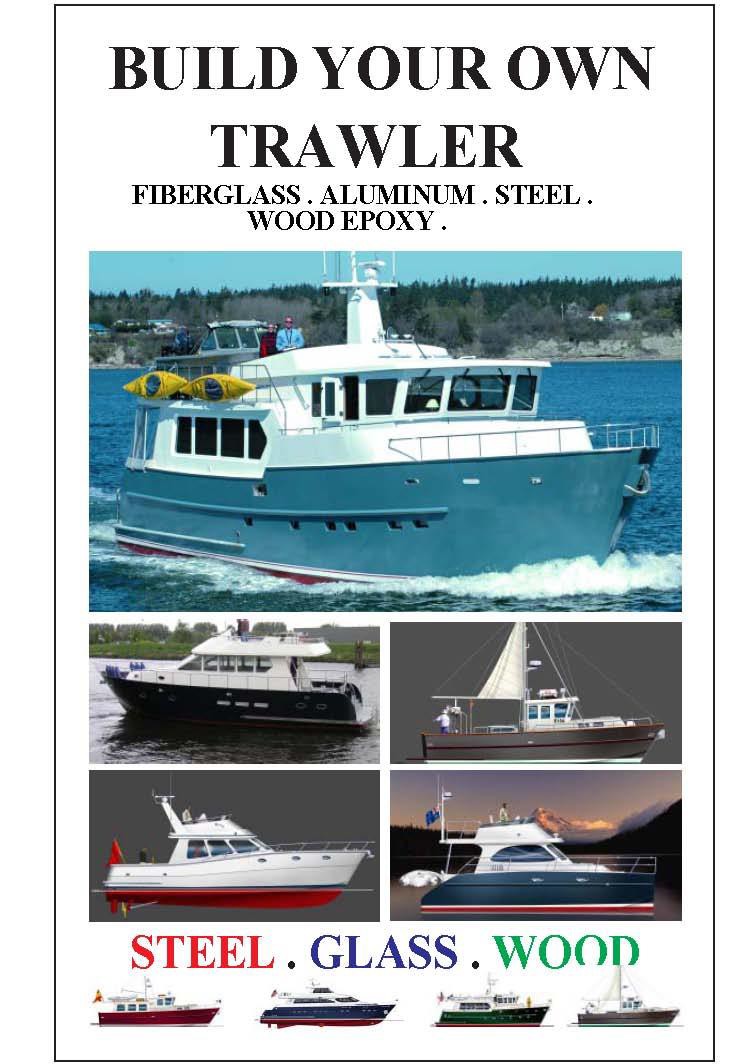
BUILD YOUR OWN
TRAWLER
SPECIAL OFFER current price
current price
current ordering page
INCLUDES ONE FREE STUDY PLAN !
Chapter 1. GETTING STARTED My boat or a family boat. Where and how will you use the boat? Where will you keep it? How much boat do you need? Using the boat to generate income. What speed RANGE do you want? What can you afford? How much will it cost? Keeping within your budget. Where to look, new orsecond-hand or build? Dealing with a broker. Surveys. Taxes. Chartering your boat. Trailerable Trawler Yachts & Cruisers Fishermen types. Chapter 2. CHOOSING THE HULL TYPE Semi-displacement or full-displacement hull types. Planing. Planing strakes. Chine or round bilge. Power Catamarans. Formulas and technical terms and what they mean. Displacement length ratios. Hull construction materials. Chapter 3. PASSAGEMAKERS History. Hull Design. Engineering. Number of engines. Fuel management. Sail assistance. Stabilising methods and equipment. Special charts and graphs.
by R. Bruce Roberts-Goodson
TO ORDER
Use the current ordering page
Chapter 4.
ACCOMMODATIONAccommodation; number of berths. Cabin soles. How many heads? Designing and equipping a galley. Various fuels for your stove (gas, diesel, alcohol, paraffin). Placement of sink and stowage of food and other stores. Showers, hot water and pressure water. Water tankage. Waste tanks. Comfortable seating; measurements and suggestions. Chart table. Sail stowage. Refrigerators and ice boxes. Lighting. Ventilation. Heating. Air conditioning
Chapter 5.
OUTSIDE LIVING.
Decks. Deck Surfaces. Fly bridges, Cockpits, Outside seating.
Deck areas for lounging. Swim platforms. Life rails .Pulpits
and bowsprits. Handrails. Deck wash pumps and their many
uses. Awnings. Hatch covers. Bimini covers. Windage
.
Chapter 6.
ENGINES AND ASSOCIATED GEAR
Single or twin. Cruising range. Diesel or petrol (gas). Single or
twin. Inboard, Stern gear. Propellers. Stern drive or outboard.
Other propulsion arrangements. Engineroom layout.
Engine compartments - Accessibility. Engine room insulation.
Engine bearers and beds. Engine mountings, Stuffing boxes
and bearings. Exhaust Systems. Understanding horsepower.
Powering your motor cruiser. Powering displacement hulls.
Powering semi-displacement hulls. Powering planing hulls.
Hydraulic-v- mechanical steering. autopilots. navigation
systems. alarms.
Chapter 7.
MARINE ELECTRICS & SYSTEMS
Electrical Installations. AC and DC systems. Managing your
electrical supply - v - usage. Domestic batteries. Engine
starting batteries. Battery chargers. Generating sets.
Chapter 8.
OTHER EQUIPMENT
Radar. radios and other communications. dinghy. inflatable
tenders. rigid dinghies. davits. Anchors and chain. anchor
winch. cleats and bitts. fenders. mooring lines.
Chapter 9.
SAFETY EQUIPMENT
Lightening protection, bonding, fire extinguishers, smoke
alarms, life jackets and life vests, harnesses and safety lines,
man overboard, emergency steering, air bags, through hulls
and sea cocks. radar reflectors, life rafts. epirb. safe sun.
guns. things to stay away from, drugs, smuggling,
pornographic literature, carrying books or videos that may
offend other cultures. Dress code.
Chapter 10.
CHOOSING THE BUILDING SITE
Location and size of space required, Building tents,
Temporary or permanent buildings.
Chapter 11.
BUILDING IN FIBERGLASS - MATERIALS & TOOLS
Fiberglass materials, chopped strand mat, continuous roving,
woven roving, resin types, core materials, balsa, foam cores,
polyester resins, epoxy resins, carbon fiber gel coats,
respirators and breathing masks, acetone, release agents,
barrier & cleansing creams, fiberglass – safety equipment, ear
and hearing protection, paint scrapers, disk sanders, mohair,
rollers, other sanding devices, fire retardant resin.
Chapter 12.
BUILDING IN FIBERGLASS – BUILDING THE HULL
Building a male mould, laying out the patterns, making the
frames, setting up the frames, the battens, adding fairing
strips, finishing the mould, open form versus solid form
moulds,fiberglass - installing the core, non-cored areas of the
hull, single skin over a male mould, laminating with a team,
finishing the hull, finishing techniques
Chapter 13.
BUILDING IN FIBERGLASS – DECKS, TANKS &
APPENDANGES.
Stern tubes, marking out the bulkheads, hardboard in-place,
deck mould, applying the deck laminate, installing the deck
core, teak-decks, bonding the bulkheads, sandwich decks and
cabin, master deck mould, female moulded and panel decks
and superstructures, bonding the deck, bulwark stiffeners,
hull deck joins, production moulds, vacuum bagging, camber
patterns, suggested joinery dimensions, interior joinery.
Chapter 14.
BUILDING IN TIMBER.
cold molding, strip planking – wood epoxy, building the
frames, assembling the basic hull structure, installing the
planking round bilge hulls, trimming the panels, planking the
hull, choice of adhesive, selecting the fastenings, fairing and
finishing the hull, turning the hull, solid floors – web floors,
traditional and not so traditional planking, ballast keels on
wooden boats, interior framing, deck beams, plywood decking
sheathing plywood decks and superstructure
.
Chapter 15.
CUSTOM BUILDING IN STEEL OR ALUMINUM - PRE-CUT KITS
Creating the design, making the calculations and preparing
the cutting files. CNC Cutting, assembling the hull deck and
superstructure. Several Roberts designed TRAWLERS are
used to illustrate all of the steps in designing and building from
a kit.
Chapters 16.
SELECTION OF TRAWLERS YOU BUILD.
APPENDICES - ADDITIONAL INFORMATION OF INTEREST.